Bernd, to start with: Is there a tracking experience you still think back on with a smile?
There are quite a few. One of them is still very vivid in my memory:
A handler’s task was to cover her dog’s eyes so that he could not see how the food was being placed for the restart. It worked well a few times.
But during one training session, she must have been somewhere else with her thoughts. I asked her, “Don’t you remember what we do with the eyes?” The handler quickly and somewhat guiltily took position next to her dog — but instead of covering the dog’s eyes, she covered her own.
What was your trickiest case?
Oh yes! I once received a call from a desperate handler. His dog was eating the articles on the track. The dog had already undergone surgery three times because of it. Another operation was no longer an option, because the dog’s stomach was already badly scarred.
We tried a lot of different things, but in the end we solved the problem like this: We only used articles that were at least the size of a mobile phone. The dog could not fit them into his mouth. We also anchored the articles firmly into the ground with long nails.
That allowed us to reward the dog again and again before he had the chance to pick up the article. Today, the dog indicates the articles correctly.
When do you start training a dog?
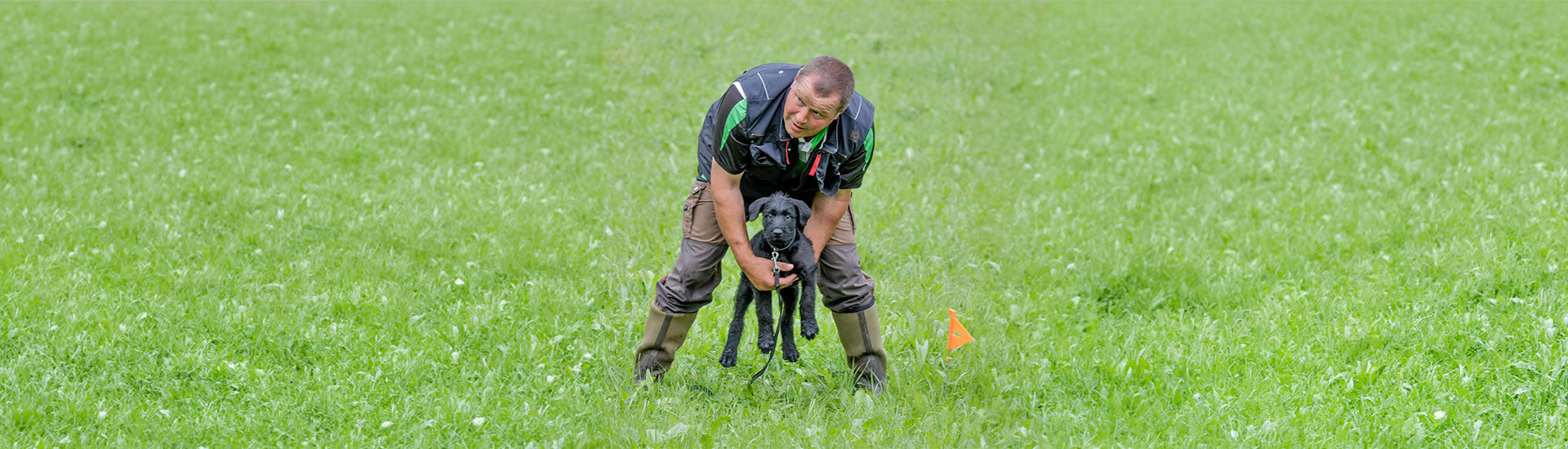
I start as soon as the dog has settled into its new home. At around 12 to 13 weeks, a puppy can already search its first track starts.
Is every breed suitable for tracking?
In my experience, basically every breed is suitable for tracking.
However, some hunting breeds can be challenging in training. Due to selective breeding, they often tend to switch into a more free-searching pattern very quickly. With short-muzzled dogs such as Boxers, food intake can also become anatomically difficult. In those cases, creativity is needed. For example, you can use food sticks that the dog can pull out of the ground.
What are the three training problems you see most often?
Many dogs struggle with speed. They are either too fast or search at an inconsistent pace.
Many handlers also find it difficult to reduce food in the right way.
Another common problem is that tracks are made too difficult too quickly. The dog is then faced with a task it cannot solve, which quickly leads to frustration for both dog and handler.
Problems at corners: Do you have any tips for us?
First, I look at the dog’s speed. If the dog is simply too fast to search attentively, we work on the pace.
If speed is not the root cause, I let the dog overshoot the corner by about one body length. Then the dog receives a verbal correction and is restarted a few steps before the corner. This gives the dog a second chance to work out the corner correctly.
Most dogs then search more carefully and learn that calm work leads to success.
Another mistake is placing too much food directly in the corner. When the dog later encounters a corner without food, many dogs become overwhelmed.
You also give seminars for interested handlers, correct?
Yes, I give many seminars. However, I deliberately keep the groups small and train with a maximum of 10 teams. The downside is that my seminars are booked out very quickly and are often held internally within clubs.
For those who are interested, I recommend attending one or two workshops as an observer first.
You now work with many dog sport handlers. How did that come about?
It started when I was working a German Shepherd and wanted to move away from the forced tracking methods that were common in the past.
I used a lot of food, but I had the problem that the dog, especially on soft fields, started searching by sight and lifted his nose. So I developed the idea of working with tins.
The principle worked, and soon many sport handlers came to me because they were interested in the method. That is also how the collaboration with Team Heuwinkl began. So you could say I gradually grew into my role.
Who was your teacher in tracking training? Did you have any role models?
I came up with most of it myself and taught myself along the way. The best teachers were the many different dogs I met at seminars.
You always have to think carefully. There is no single concept that works for every dog.
You have been involved in dog sport for many years now. Has tracking changed over the years and decades?
Yes, very much so. In the past, there was a lot of compulsion in training. Then there was a phase in which many dogs almost searched too happily and freely.
At the moment, I feel that the trend toward absolute perfectionism is becoming stronger and stronger. Instead of helping dogs enjoy the work, many handlers are too focused on training a very exact search behavior.
What do you enjoy most about tracking?
I love seeing the progress dogs make. For example, a young dog where you can see month by month how it improves and masters new tasks.
I also really enjoy helping handlers who are facing difficult problems with their dogs. Recently, we were able to help a dog that had previously searched under a lot of pressure rediscover joy in tracking. That was a great feeling.
And of course, when training partners score 100 points at the World Championship, that makes me happy too. laughs
Bernd, thank you very much for taking the time for us.
Related: Training equipment for tracking work