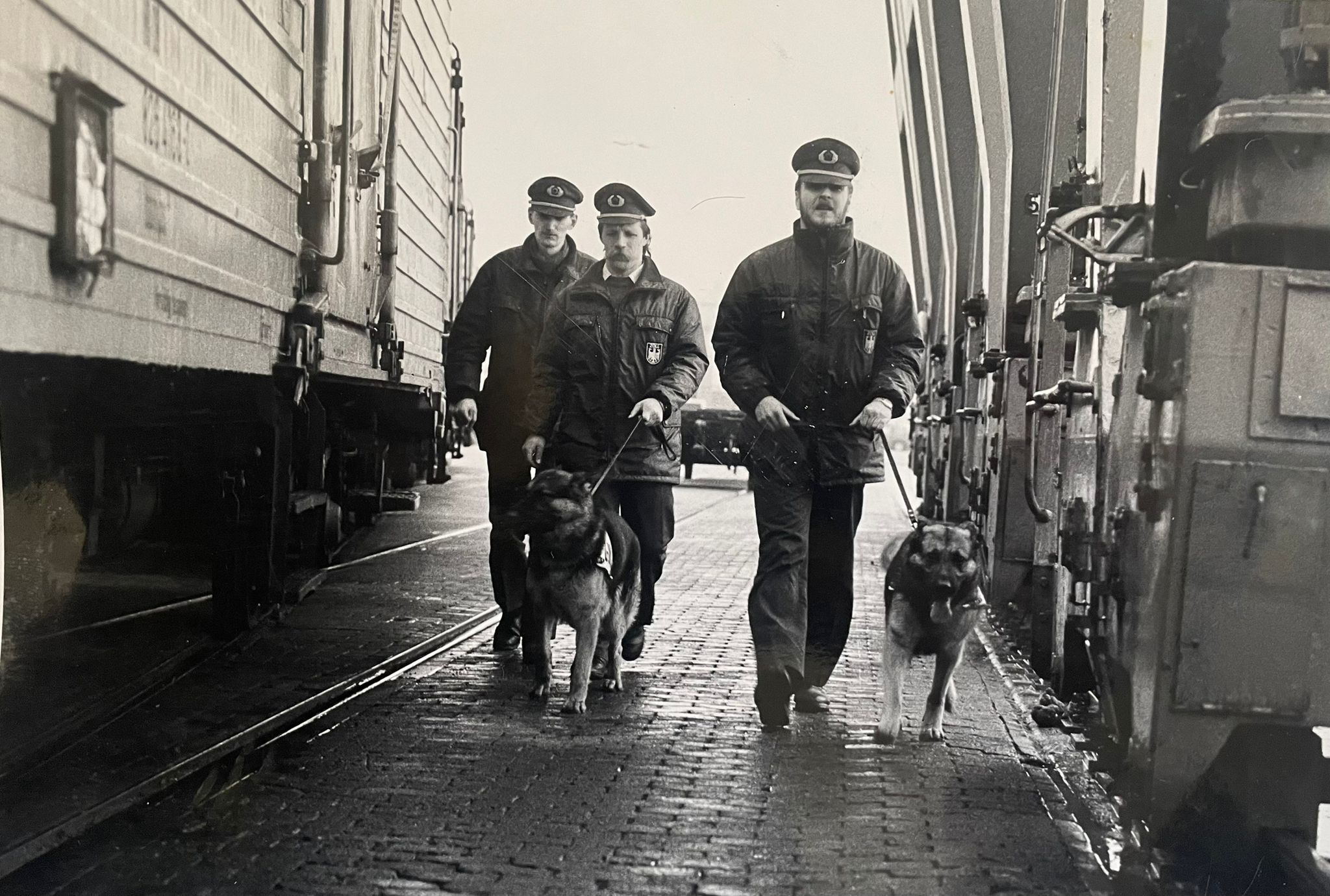
We had the opportunity to speak with K9andSports ambassador Horst-Dieter Träger (Dieter), who has insight into the service dog field as well as into sport and breeding. Dieter is a service dog trainer with the customs service and is responsible for purchasing and training for the state of Bremen. Since 1982 Dieter has also run the SV kennel von der Wannaer Höhen; he is a performance judge for the SV and has handled dogs very successfully himself.
Patricia: You once told me that you are not a political person. Yet you are very active with K9andSports. Why?
Dieter: I think it is a good thing to bring dog sport and the service dog world closer to the public and to be transparent. After all, this is a good cause from which society benefits. There is no need for us to hide.
At the authorities, for example, we would have serious problems if there were no private working dog breeders and trainers. It would be even harder to get hold of good quality dogs.
Perhaps partly because there is a lack of information, the sport and breeding approval tests are increasingly being watered down. That carries the risk that we lose the quality of our dogs. But we depend on good quality in order to maintain our service.
Patricia: And why do you need the private sector in order to get dogs for the authorities?
Dieter: Because the authorities on their own cannot breed on the scale on which dogs are needed. At a workshop I was able to discuss this with the Bundeswehr, the German armed forces, which runs its own breeding programme. But that is limited to two, perhaps three litters a year. And not all of those dogs are suitable for service either.
The actual need for service dogs is simply too great for the authorities to cover it on their own. That is why the majority of the dogs deployed by the authorities come from private breeders. The selection of the dogs used for breeding therefore lies in private hands. The authorities then make the best of what they get – and my impression is that quality has dropped off somewhat in recent years. Of course, we work with a limited budget while prices rise. That is why I hope that with K9andSports we can put breeding and breeding selection front and centre – because those are the decisive points where the course is set.
Patricia: What kind of dogs do you need, and do you always train dual purpose?
Dieter: For a while there was a tendency to move away from protection dogs. Some department heads preferred to buy "pure" detection dogs. That was a way of avoiding the high training effort that comes with dual training.
In recent years in particular, attacks on officers have increased significantly. Personal safety is becoming an ever more pressing issue. Unfortunately we increasingly find that the people we approach count on us not using, or not being allowed to use, our weapons and disregard instructions. With a service dog at your side, that happens far less often. Accordingly, we are again giving more weight to the protection side of our dogs.
Patricia: Does it really make that much difference whether you have a dog with you?
Dieter: Yes, absolutely. The difference between acting with or without a dog really is considerable. A dog is not as predictable for the "other side".
Unfortunately, getting hold of good dogs at all is a big problem. My duty station, for example, is Bremerhaven. If you work there, you experience an extreme wall of noise. Often the dogs first have to go up a 30 m gangway before they get on board. On the ship or in the container, temperatures are frequently high. It is anything but a given that dogs still work with motivation and stamina in that environment. That takes a dog of very good quality.
Patricia: How do you check the quality of the dogs before you buy them?
Dieter: At first it looks similar to the DMC breeding suitability test: first the handler and I as the trainer play with the dog. Then the dog should show that it is willing to "fight" for the prey.
Most dogs run like mad when they have just seen a ball fly away. A completely different picture emerges when the prey is "dead". You can often see that as soon as you throw the toy away and then turn the dog on the spot. Some dogs have no task left at that point: some no longer search at all, others lose intensity or give up after a very short time. You can also spot whether a dog has only learned the visual search: that happens more often than you would like to believe.
Patricia: What about environmental soundness?
Dieter: I always look at how a dog behaves in an unfamiliar environment: in halls, on slippery floors and so on. However, on the basis of a single assessment it is often hard to tell whether a dog is showing good drive behaviour or a high level of nervous activity. At first that can look very similar. And then you are surprised on deployment.
That is basically another reason why we have a four to five week trial period when buying a dog, so that we can rule out behaviour that would impair service. We have had dogs that refused to go any further once they saw an automatic glass door at the airport or found themselves on a slippery floor.
Through training and habituation you can give such dogs a good deal of confidence. In my experience, though, they regularly will not deliver the peak performance of a dog that is naturally environmentally sound. Generalising a behaviour is very time-consuming. And we do not have that time.
Florian: Exactly, that is a very critical point for us too in the breeding assessment: does a dog show activity out of temperament or because of weak nerves? It really is difficult to tell. What is certain, though, is that we do not want a dog that shows activity out of excessive nervous activity. The dog should be intrinsically motivated. What can you tell from the sport?
Dieter: As a judge I watch a lot of dogs at trials. A trial is a good opportunity to establish differences between dogs. But a conclusive statement about a dog's character cannot be made on the basis of a trial alone.
At the SV, incidentally, I always like to watch how the competitors make their way to the neighbouring field with their dogs for the awards ceremony. You see dogs that do not settle at all, or that come out of the trailer already stressed and panting. With a working dog it matters to me that it can also settle. If it cannot, for me that means a clear limitation.
Patricia: Do I understand correctly: the sport alone is not enough as a selection?
Dieter: The sport provides a certain amount of selection. But not a conclusive one. We always need breed surveys or breeding suitability tests in addition. A complete picture only emerges when we assess the dogs within the programme (the trial) AND outside the programme.
I once had a bitch I was very happy with after she had done her IGP 1. She made a good impression there. Four weeks later I took this bitch to a show where shots were also fired. That shot visibly affected her. At first you ask yourself how that can be, because she had shown nothing of it at the level 1 trial. But that trial was her programme, a fixed sequence that carried her through. That experience taught me something: when dogs know and anticipate their routines, traits can be masked to the point where we do not even notice them as handlers.
Florian: Gun steadiness – is that an important topic for you?
Dieter: Yes, in the broader sense. Gun steadiness is undoubtedly important in practice. But it goes hand in hand with noise (in)sensitivity, which is at least as important on deployment. I have already mentioned the wall of noise at the port of Hamburg: among other things, iron plates frequently drop to the ground there. The noise this creates far exceeds that of a shot. It is essential for us that our dogs stay stable within that kind of noise as well. We cannot do without it.
Patricia: I recently read that noise sensitivity in dogs, regardless of breed, is said to have increased sharply in recent years. The cause can be genetic, or it can be imprinting. At the DMC we currently see practically no noise sensitivity in the Malinois. And if the DMC's breeding selection works, noise sensitivity should not increase in that context either. A dog that is not gun steady does not get breeding approval.
Dieter: I do indeed test every dog for gun steadiness (9mm). Not in training, though, but when the dog is "off duty", for example running around in a meadow. The odd dog does turn out to be sensitive. But we are not seeing an increase in noise sensitivity. We have bigger problems with the dogs' nerves. You see that in the German Shepherds of the working lines too. I attach a lot of importance to the dog having good prey and reacting correctly to pressure. But none of that is enough; the dog has to have stable nerves and be able to come back down again. If a dog cannot do that and is still over the top half an hour after the pressure, then in my view it does not belong in breeding.
Patricia: You said you had watched the ZTP, the "small" breeding approval in the DMC, of my dog: what was missing for you? What else would you have wanted to see as part of an assessment?
Dieter: I liked a good deal of it, and other things were missing for me.
You had to walk through the group of spectators with the dog off lead. The dog was neutral and at the same time did not "cling" to you. I liked those walk-through elements. But I would ask for them on a larger scale.
I also liked the play: when your dog had to jump into the tunnels and canisters and show activity in order to fetch the toy.
But: prey behaviour can mask character. I would like to see the dog assessed for how it presents when it is not in drive as well; whether it then also masters slippery floors, grating and a jump onto an obstacle. With prey involved, the result is not real for me.
Florian: That is a good point. We have already had many discussions with authorities that keep service dogs. We see the benefit of assessing difficult environmental conditions without drive.
Patricia: Do you assess anything else in terms of nose work?
Dieter: Yes, we have the dogs search with more stamina in various situations. For example, we take the dog out of sight after we have thrown a ball. Only after one or two minutes, when the stimulus of the prey flying away is no longer present, do we release the dog. Ideally the dog still searches with stamina. It matters less to us whether the dog finds the ball; but it should be willing to search for two or three minutes.
At our dog school we have many rooms available for nose work. Here they have to get over obstacles such as large sheet-metal-clad heating pipes, or we hide the ball in a tower of empty 5-litre canisters that topples over during the search. The clatter impresses some dogs so much that they will no longer go near the canisters.
Those are essentially the additions I would recommend for your breeding assessment. The key phrase is resilience without stimulus and without expectation.
Florian: Those are very good additions to the ZTP: assessing how the dog deals with pressure without drive. Another topic is frustration tolerance and drive persistence. Our exercises there are still too easy. Yours, by contrast, are considerably more demanding. From the outside it may not look difficult – but for the dog it is.
Patricia: Now one more question about the sport: what is your view on abolishing the pressure phase, or the stick hits, in IGP?
Dieter: I think it is a shame that they are being abolished. In my view it is probably all just a concession to public opinion. If you look at the pressure applied with the soft stick, it is very little pressure anyway. The topic is not an absolute priority for me, though: in my 20 years as a judge I have not yet seen many animals leave the helper because of the stick hits. Often the dogs go during the pressure, before the stick hit.
Florian: As you say, some dogs already have the problem before the stick comes. Do you think that has to do with the stick already having a meaning from training? Would the dog have the problem too if it had never been confronted with it?
Dieter: Yes, it may well be that the stick then loses its meaning.
Patricia: You have been a judge for 20 years. Why do you do it?
Dieter: I enjoy judging. I have been a breeder for years. Sensible selection requires a sensible way of judging at trials. Even if the selection is not comprehensive, it is still an important part of it. For me, judging therefore has an important breeding aspect.
Patricia: What do you not like to see at trials?
Dieter: Passive biting. A full and calm grip alone is not enough for me; I also want to see a certain amount of activity. That is not encouraged by all judges, though, when they mainly criticise a restless grip while the dog is actually dominating really nicely. For me it is more important that the dogs are active in the bite than that 2 cm of fullness are occasionally missing.
Patricia: When does your heart leap?
Dieter: When a dog effectively blocks the helper. Taking into account the rest of the protection work, of course. Dogs with thin nerves also block "well" when they want to get behind the helper in order to have more peace there. But when the dog blocks effectively out of conviction, then my heart leaps.
The most important exercise for me, though, is the back transport, which for me says more about the quality of the dog than the long bite. In the back transport the dog shows good obedience on the one hand and on the other then has to engage with the pressure IMMEDIATELY and wholeheartedly. That is a very complex exercise with a high selection value.
In the long bite, by contrast, the dog first has 30 or 40 metres to think about what it is going to do. The prey is sometimes visible 20 metres in advance, and I am not sure in every case whether the dog has understood its task correctly. The attack out of the back transport, on the other hand, is a very complex exercise with a high selection value for me.
Florian: I agree with you. We really see that a lot with the Malinois. The dogs run down the field as if they were gassed, but have no idea why they set off, and then run straight past or do not bite properly. I think some people mistake speed for a certain quality.
Dieter: Something else comes to mind. I watched the video of your last IGP trial, Patricia. And I noticed that the interval between the escape and the defence was not in line with the trial regulations. The dog had only just outed and it went straight on. There should be five seconds in between. The dog has to have the chance to make a mistake :), and besides, the required guarding cannot be assessed otherwise.
I like to look at what happens in other organisations. In the SV, too, we have recurring issues. In my view, cross-organisation helper tests would make sense, which could help to standardise the way the helper works at trials. The opening, for example, absolutely should be standardised. Correctly, the opening is made with pressure; not with a prey stimulus.
In reality we see a prey stimulus in 90% of cases. After the escape, the helper should leave the arm properly out in front and then open with pressure. Standardisation would help handlers by bringing reliability.
Florian: That is indeed an important lever. If the helper's style were standardised, as a judge you would have the opportunity to influence training. If you specify how the helpers have to present, the correct form will establish itself given a little time.
Dieter: Yes, and sometimes it has to hurt, otherwise we do not change. Some breeds, and unfortunately the German Shepherd is one of them, have a striking number of problems with jumping, for example. From my point of view this is a question of genetics, since training is largely the same across all breeds. Here, too, judges can exert influence. If a dog sizing up the hurdle on the way out and back leads to an upper "insufficient" or a low "satisfactory", something will change over time.
Patricia: IGP is a very time-consuming sport. Can you think of approaches to make it more accessible?
Dieter: You could consider testing a quartering search for articles in phase A instead of tracking. Finding tracking ground is not easy in many areas. A quartering search can be set up very easily on a side field within your own training group. That would make the sport simpler to do, and at trials and competitions we would even have spectators for phase A. Almost no one watches it now.
Florian: What could be assessed in a quartering search like that?
Dieter: The article work is there in this format too. You can also assess biddability, in other words that the dog can be steered and directed well. And if the dog only runs from A to B and otherwise does not search, I can already grade the intensity with which it works the area.
Patricia: Thank you, Dieter. That was another very interesting conversation.
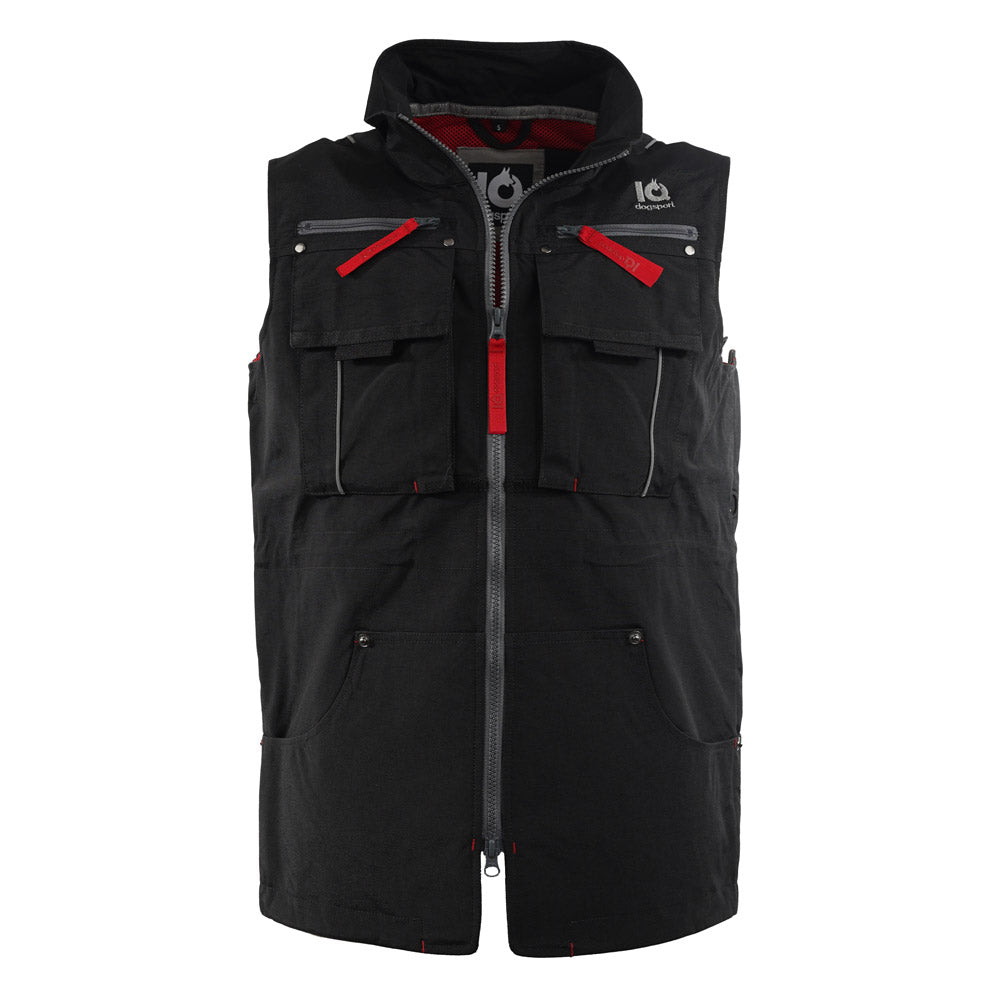
Related: Equipment for service dog handlers
About the manufacturer
IQ Dogsport is a German manufacturer of dog sport equipment, based in Pfaffenhofen, Germany. The range covers dog sport vests, multi-function and training jackets, reward systems and IGP training equipment – in service with K9 handlers in the police, customs service, prison service and armed forces. More about IQ Dogsport