Clothing for dog owners, dog walkers, and dog handlers for walks or dog sports consists of more than just a good jacket and trousers . The right socks are also crucial , because there's nothing worse than cold, wet feet when you're out with your dog. That's why we've included thin and warm waterproof socks in our product range. Whether you're into IPO, agility, obedience, or competitive dog sports (THS), you want to wear shoes that are comfortable and provide good support. But football boots or cleats, which offer good grip in agility, THS, or even protection work, aren't waterproof. As I've experienced myself time and again, many hiking boots are only waterproof initially; after a while, the membrane breaks down and the shoe becomes leaky. Waterproof socks provide the solution. Wear your preferred shoes for dog sports or walks and, thanks to our waterproof socks, your feet will always be dry and warm.
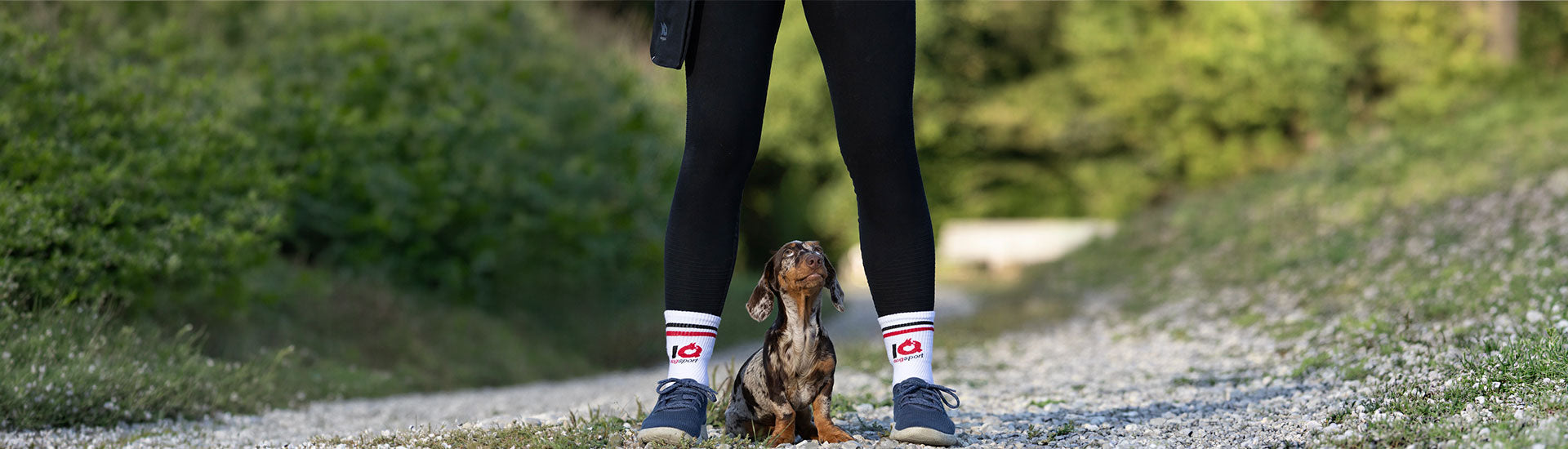
Waterproof socks for dog owners, dog sports enthusiasts
Related Posts

Working Dog Heat Safety: Why Your Dog Shouldn't Carry a Bite Sleeve After Training
Warum dein Hund bei Wärme nach dem Training nichts im Fang tragen sollte – kein Hetzarm, kein Spielzeug, kein Apportel – und wie du ihn richtig und schnell runterkühlst. Praxiswissen mit Studienbelegen.
Learn more
Working Dog Operations Explained: Duties, Training and Equipment Overview
WHAT ARE WORKING DOG OPERATIONS? Working dog operations encompass the training, handling, and deployment of dogs used for clearly defined official, security, law enforcement, or military tasks. Depending on their role, working dogs may perform a wide range of duties, including protection work, apprehension, human scent detection, tracking, article searches, and specialized detection work. This versatility is often underestimated. Working dog operations involve far more than protection work or apprehension scenarios. A significant portion of modern working dog work is based on the dog's nose. Dogs search for people, track human scent, locate objects, and identify specific target odors. Detection dogs may be trained to locate narcotics, explosives, currency, electronic storage devices, accelerants, or other operationally relevant scent pictures. What matters is not appearance but reliable performance in a clearly defined task. A working dog must be motivated, resilient, controllable, and capable of working appropriately in demanding situations. The dog must be independent enough to solve problems while remaining responsive to the handler and integrated into the overall mission. WHAT MAKES A GOOD WORKING DOG? A suitable working dog requires far more than drive. Motivation is important, but it must be channeled correctly. A working dog should work actively without becoming uncontrollable. The dog must be resilient under pressure while remaining responsive to the handler. It should be capable of searching, tracking, or securing independently without operating outside the handler's control. Environmental stability is equally important. Depending on the assignment, working dogs may encounter buildings, vehicles, slippery floors, darkness, loud noises, crowds, confined spaces, and constantly changing terrain. A dog that only performs reliably in familiar training environments is only partially prepared for real-world deployments. Key characteristics include: Strong nerves and confidence Environmental stability Trainability and handler focus Physical endurance Reliable indication and working behavior Clear communication with the handler The ability to switch between high drive and control Successful working dog performance is never accidental. It results from suitable genetics, systematic training, experience, and skilled handling. WHY WORKING DOG OPERATIONS ARE ALWAYS A TEAM EFFORT In working dog operations, it is never just the dog that works. It is always a team: handler and dog. The dog contributes its abilities—its nose, attention, search behavior, speed, endurance, and reliability under pressure. The handler must direct those abilities. The handler reads the dog, evaluates situations, delivers rewards correctly, provides clear communication, and knows when to intervene or allow the dog to work independently. In practice, a working dog handler is responsible for much more than handling the dog. Equipment, radios, identification panels, leashes, rewards, paperwork, and operational gear must all remain accessible without restricting movement. That is why functional clothing is more than a comfort feature in working dog operations. Equipment such as the IQ K9 Working Dog Handler Vest Pro Black is designed specifically for this environment. It provides storage capacity, identification panels, body camera attachment points, radio loops, and quick access to mission-critical equipment. In dynamic situations, equipment must be immediately available rather than buried inside a bag. WHY WORKING DOG EQUIPMENT REQUIRES A DIFFERENT APPROACH Traditional dog sport clothing is primarily designed for training. Working dog equipment often needs to do much more. It must be durable, allow unrestricted movement, carry essential gear, and remain organized at all times. Depending on the operational environment, identification, color requirements, and rapid access to equipment can also be critical. A good example is the IQ Police Dog Handler Vest Blue. It is designed for environments where a professional appearance, identification options, and practical handler functionality are required. Its value comes not simply from additional pockets but from combining operational functionality, identification capabilities, and fast access to equipment. Working dog operations also take place in all weather conditions. Training, searches, and deployments may involve rain, wind, cold temperatures, darkness, or long waiting periods. If the handler becomes cold, soaked, or unable to organize equipment effectively, performance suffers. Products such as the MFJ K9 Pro Black Tactical Dog Handler Jacket were developed specifically for these demands. Designed for professional K9 handlers, the jacket offers weather protection, insulation, body camera loops, holster access, rear storage pockets, and removable treat pouches, helping handlers remain organized and effective even under difficult conditions. WORKING DOG OPERATIONS ARE NOT JUST PROTECTION WORK One of the most common misconceptions is that working dog operations consist primarily of protection work. Protection and apprehension tasks can be important components, but they represent only part of the field. A major area is scent work. Search work serves as the umbrella term and may include human scent detection, tracking, article searches, and detection work. Detection work generally refers to locating specific target odors that have been conditioned through training, such as substances, objects, or human scent signatures. In practical applications, the dog must do far more than simply "search." The dog must work systematically, persistently, and reliably. It must recognize a target odor, distinguish it from competing environmental stimuli, and communicate the find clearly to the handler. For this reason, training development in scent work is highly demanding. Repetition is important, but training must not become predictable. If search locations, hiding spots, surfaces, and reward placements remain unchanged, dogs may learn patterns rather than true scent discrimination. Tools such as the IQ Magnetizer can help create more varied and realistic training scenarios. By allowing toys, bite tugs, bite pillows, or scent containers to be positioned magnetically, trainers can create more diverse reward placements and less predictable search environments. This can be particularly useful in scent work, detection training, and professional K9 applications. Training aids do not replace proper training systems, but they can help make training more versatile, practical, and realistic. WHY CONTROL MATTERS MORE THAN TOUGHNESS Working dog operations are sometimes associated with toughness. In reality, control is far more important. A working dog must be capable of operating with intensity while remaining fully manageable. Depending on the task, the dog may search, indicate, apprehend, or secure. At the same time, the dog must also stop, wait, redirect, and respond immediately to the handler. This applies equally to detection work and protection work. A dog with unlimited energy but limited control quickly becomes a liability. A dog that lacks initiative and confidence will also struggle to perform reliably. Successful working dog performance depends on balance: clear drive within clear rules. The dog should want to work while remaining controllable. It should solve problems independently without becoming disconnected from the handler. The ability to switch between activation, control, and renewed engagement is one of the defining characteristics of a well-trained working dog. WHAT SPORT DOG HANDLERS CAN LEARN FROM WORKING DOG OPERATIONS Dog sport and working dog operations are not the same. Sport follows fixed rules and exercises. Working dog operations focus on practical objectives and constantly changing situations. Nevertheless, there are valuable lessons that sport handlers can learn from professional working dog programs. One important lesson is environmental stability. A dog should not perform only on a familiar training field. Exposure to different environments, surfaces, sounds, and distractions helps build more reliable performance. Equipment management is another transferable skill. Handlers who constantly search for leashes, rewards, toys, or training aids lose timing and clarity. Well-organized equipment does not automatically improve training, but it helps handlers work more efficiently and consistently. Perhaps the most important lesson is mindset. It is not enough for a dog to perform under ideal conditions. The real question is whether the dog can perform reliably under distraction, pressure, and changing circumstances. 5 COMMON MISCONCEPTIONS ABOUT WORKING DOGS 1. Working dog operations are only about protection work Protection and apprehension tasks represent only one part of the field. Many working dogs primarily perform search, detection, or other specialized tasks. 2. A working dog simply needs to be tough Resilience, control, and proper training are far more important than toughness alone. 3. Motivation replaces training Drive is important, but without structure, indication behavior, obedience, and clear communication, it remains unreliable. 4. A successful sport dog automatically makes a good working dog Dog sport and operational work require different skill sets. A dog can excel in sport while being unsuitable for certain working roles. 5. Equipment is unimportant In working dog operations, equipment must function reliably. Storage, accessibility, weather protection, identification, and freedom of movement can directly affect performance. CONCLUSION: WORKING DOG OPERATIONS ARE TASK-ORIENTED WORK Working dog operations are far more diverse than many people realize. They include protection and apprehension tasks, human scent detection, tracking, article searches, and specialized detection work. At the center of all these disciplines is reliable performance in a clearly defined task. A good working dog requires suitable genetics, training, resilience, and skilled handling. The dog must be independent enough to solve problems while remaining controllable enough to work safely as part of a team. Likewise, handlers need structure, experience, and functional equipment. Effective working dog performance is not built on toughness or luck. It is built on training, teamwork, communication, and the ability to perform reliably under challenging conditions. Related: Complete K9 Handler Equipment Collection · Dog Sport Training Equipment
Learn more
IGP Protection: Why Great Protection Training Doesn’t Start with the Bite
This article is part of our guide: What Is IGP? Tracking, Obedience and Protection Explained. IGP Protection: More Than Barking, Blinds and the Bite The Protection Phase is probably the most visible—and most misunderstood—part of IGP. From the outside, people see speed, barking, the helper, blind searches and the bite. Because of that, many assume protection training is primarily about teaching a dog to bite. In reality, the opposite is true. Great protection training is not uncontrolled action. It is education, structure and communication under high levels of arousal. The dog must search for the helper, perform a bark-and-hold, engage confidently when required, immediately release on the out command and remain responsive to the handler throughout the entire exercise. That is far more demanding than it appears from the sidelines. The goal is not to create an overly excited dog. The goal is to channel energy into a clear task. The dog should work with intensity while remaining mentally present and responsive. It should show confidence and commitment while staying within a well-structured training system. That’s why great protection training doesn’t start with the bite. It starts with structure, control and a systematic foundation. What Does the Protection Phase Include? The Protection Phase consists of several individual skills that are later combined into a complete trial routine. These include: Blind searchBark-and-holdPrevention of escapeDefence against attacksThe out commandGuardingHandler control between exercises Each skill places different demands on the dog. During the blind search, the dog must actively hunt for the helper and work independently away from the handler. During the bark-and-hold, the dog must confidently indicate the helper without making contact. During engagement work, the dog needs confidence, commitment and the ability to remain clear under pressure. During the out command and guarding phases, the dog’s impulse control becomes visible. Even under high arousal, it must remain responsive and controllable. It is this constant switching between intensity and control that makes the Protection Phase so challenging. A good protection dog doesn’t simply go forward. It knows when to go forward—and when to stop. Why Blind Search Training Is Often Underestimated Many newcomers focus almost entirely on the bite. Experienced trainers often pay much more attention to the blind search. The quality of protection training frequently becomes visible long before the dog ever reaches the helper. A dog should not run the blinds simply because it has memorised a pattern. It should understand the task. Strong blind search work is characterised by: purposeful searching,independence from the handler,commitment to every blind,and a clean transition into the bark-and-hold. Problems typically appear when training becomes too predictable. Dogs begin running familiar routes instead of actively searching. They shortcut blinds, lose intensity or become uncertain as soon as the picture changes. That is why variation matters. The IQ Pop-Up Blind was developed specifically for mobile blind-search training. The lightweight foldable blind can be set up quickly and transported easily, allowing handlers to vary training locations, distances and search patterns. This helps dogs learn the concept of searching rather than memorising a particular field layout. For serious protection training, that distinction is critical. Control Is Not the Opposite of Motivation One of the biggest misconceptions in protection training is the belief that handlers must choose between motivation and control. In reality, high-level IGP requires both. A dog that is fully controlled but lacks energy will struggle to impress in competition. A dog with endless energy but no control is equally problematic. The goal is a dog that works with confidence and intensity while remaining responsive at all times. This becomes most visible during transitions: before engagement,after engagement,during the out command,while guarding,and when returning to handler control. These moments are often less spectacular than the bite itself. But they reveal the true quality of the training. Many future problems begin here. Dogs may become unreliable on the out command, guard inconsistently, struggle to settle after high arousal or lose clarity between exercises. Protection training is therefore about far more than engagement work. It is also about impulse control, obedience and communication under pressure. Why a Harness Has a Real Function in Protection Training During protection training, dogs often work with significant forward drive and physical commitment. This occurs during bark-and-hold exercises, restraint work, back-tie exercises and many other training situations where the dog pushes powerfully into the line. In these moments, a harness is more than just equipment. It directly affects: breathing,freedom of movement,force distribution,stability,and overall comfort. The IQ Performance Pro Cobra was developed specifically for demanding training environments such as IGP, protection training and service-dog work. The design focuses on: unrestricted breathing under load,efficient force transfer,reduced pressure points,full range of motion,and secure handling during high-intensity work. The pulling force is directed between the front legs toward the sternum, helping to keep the throat and airway free while maintaining stability under pressure. In protection training, equipment should never be chosen for appearance alone. It should be selected for function. The Bite Is Important—But It Is Not the Beginning Engagement work is certainly part of protection training. But handlers who focus only on the bite miss the bigger picture. Before the dog ever engages, it must understand the situation. It must know: when to search,when to perform a bark-and-hold,when engagement is appropriate,and when to release. The dog must learn to work through pressure without losing clarity. It must be able to return to a controlled mental state after periods of high arousal. That is why protection training should never be built around impressive pictures alone. A spectacular bite means very little if the dog cannot perform a clean bark-and-hold, struggles with the out command or becomes difficult to handle afterward. The book Gemeinsam erfolgreich zum meisterhaften Schutzdienst explains the development of modern protection training step by step, from young dogs to trial-ready competitors. It is especially valuable for handlers who want to understand the training logic behind the exercises rather than simply copying individual drills. What Does Great Protection Training Look Like? Great protection training is not defined by noise, speed or spectacle. It is defined by clarity. The dog works actively and confidently while remaining controllable. It accepts pressure without becoming frantic. It shows commitment without losing focus. It can switch from intensity to obedience and back again. That is the difference between action and education. Beginners often focus on the bite. Experienced trainers watch something else: How does the dog enter the work? How well does it think under pressure? How does it respond to guidance? How does it handle conflict? How quickly does it recover? That is where quality becomes visible. Five Common Beginner Mistakes in IGP Protection 1. Making the Bite the Centre of Everything The bite is important, but without blind searches, control and clear transitions, the training remains incomplete. 2. Treating Blind Searches as a Running Exercise The dog should actively search and understand the task rather than simply follow a memorised route. 3. Delaying Control Training The out command, guarding and handler control should be developed from the beginning. 4. Underestimating Transitions Entering the work, restraint, release and re-engagement are all critical training moments. 5. Using Everyday Equipment for High-Intensity Training Protection training creates unique physical demands that require appropriate equipment and safe handling. Final Thoughts: Protection Training Is Education Under High Arousal The Protection Phase of IGP is not simply action around a helper. It is a sophisticated training discipline that combines motivation, confidence, impulse control, resilience, engagement work, blind searches and obedience. A great protection dog wants to work but remains responsive. It shows intensity without losing clarity. It engages confidently and releases immediately when asked. It searches actively, performs a confident bark-and-hold and works as a team with its handler throughout the entire exercise. That is why great protection training does not begin with the bite. It begins with structure, control and thoughtful training. Tools can support that process when used correctly. The IQ Pop-Up Blind brings variety and realism to blind-search training. The IQ Performance Pro Cobra was designed specifically for high-load training situations involving movement, restraint and control. And Gemeinsam erfolgreich zum meisterhaften Schutzdienst provides a structured roadmap for handlers who want to understand protection training—not just perform it.
Learn more